
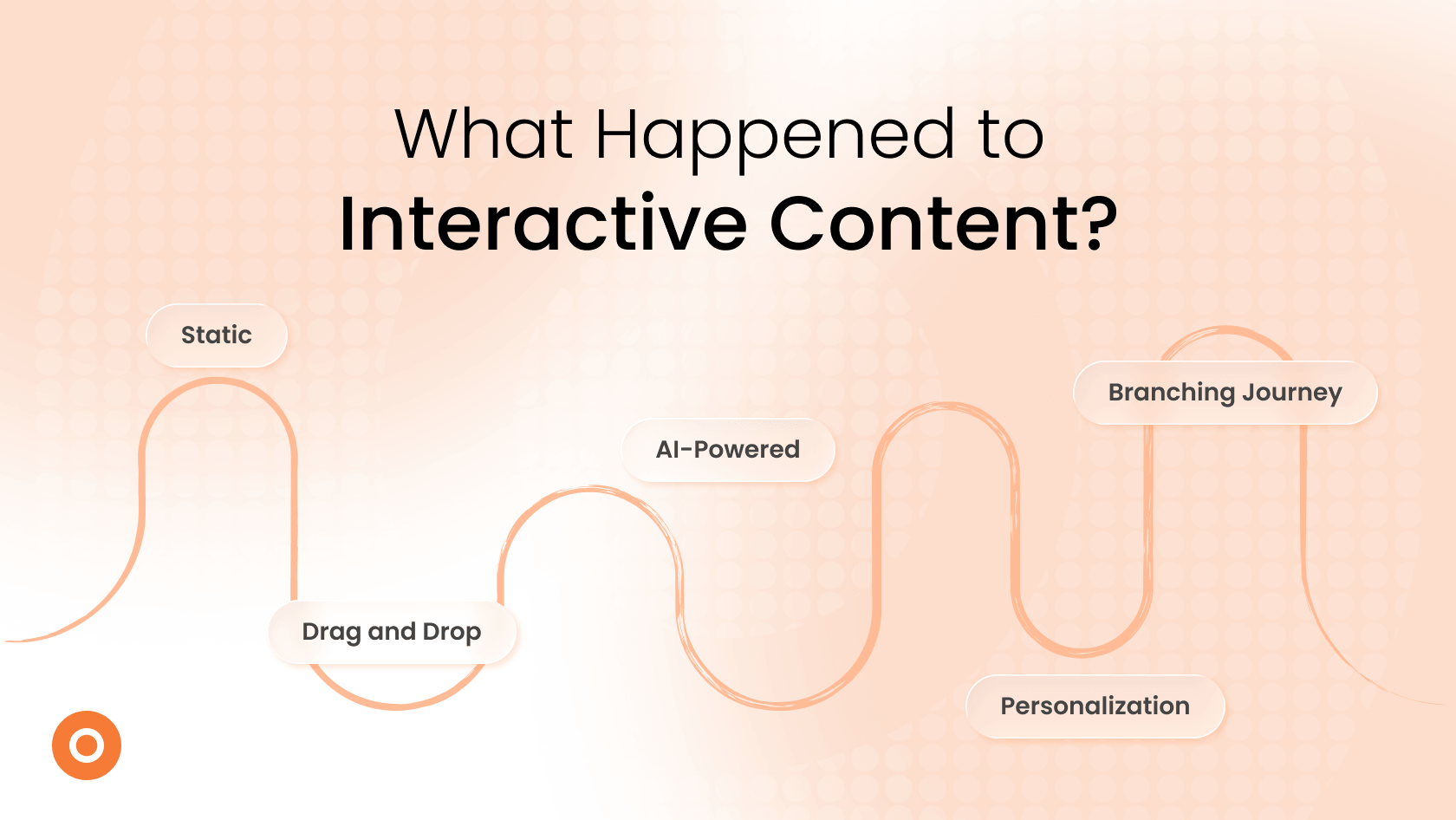
Interactive Content has changed a lot in three years. In MarTech, three years is a long time.
AI got smarter, customer expectations got higher, and marketers got approximately 47 more tools to keep track of.
Interactive Content changed too.
Dot.vu has now been recognized by the MarTech Breakthrough Awards for three consecutive years. In 2024, we won Best Interactive Content Platform. In 2025, Best MarTech No-Code Solution. And in 2026, we received both the Interactive Content Innovation Award and Customer Journey Orchestration Platform of the Year.
Nice? Absolutely.
But the interesting part is not the growing collection of award badges.
It is what those categories say about how much Interactive Content has evolved in only three years.
So, let’s rewind.
- 2024: Interactive Content needed to do more than sit there
- 2025: Creating Interactive Content had to get easier
- AI changed where the creation process begins
- Interactive Content became part of a bigger customer journey
- So, what should marketers expect from Interactive Content now?
- Three years later, the bar is higher
2024: Interactive Content needed to do more than sit there
A few years ago, one of the biggest conversations around Interactive Content was simple: static content was struggling to keep people involved.
- A PDF could explain something.
- A landing page could present an offer.
- A traditional video could tell a story.
But the audience mostly sat on the receiving end.
Interactive Content changed that relationship.
Quizzes asked questions. Calculators helped people work something out. Product finders guided decisions. Interactive Videos let users choose what happened next.
Instead of consuming content, people participated in it.
That mattered because participation created more opportunities to learn what audiences cared about, personalize the experience, and guide them toward a relevant next step.
By 2024, Interactive Content was already moving beyond novelty.
The expectations were getting higher.
Marketers wanted flexibility over logic and content flows. They wanted experiences that reflected their branding, interaction data they could use, and they wanted their Interactive Content to work alongside CRM systems, marketing automation platforms, and the rest of their existing stack.
That year, Dot.vu was named Best Interactive Content Platform by MarTech Breakthrough.
The bigger takeaway was clear: making content interactive was becoming less about adding something flashy to a campaign and more about making digital experiences useful, measurable, and relevant.
2025: Creating Interactive Content had to get easier
Once brands started doing more with Interactive Content, another problem became pretty obvious.
Someone still had to build all of it.
And if every quiz, calculator, recommender, or guided experience required developers to step in, things got complicated fast.
Interactive Content needed to become easier to create without becoming painfully basic.
That is where no-code creation became increasingly important.
By 2025, marketers were no longer limited to simple polls and quizzes. Teams were creating ROI Calculators, Product Recommenders, loyalty experiences, Interactive Presentations, Marketing Games, and other more advanced experiences.
At the same time, businesses needed different levels of control.
Some teams wanted to start quickly with templates.
Others wanted full drag-and-drop customization.
Enterprise organizations needed user permissions, global campaign management, integrations, analytics, scalability, and enough flexibility to handle far more complex projects.
In other words, “no-code” could no longer mean “you can change the headline and button color. Have fun.”
It needed to support serious work.
Dot.vu was recognized as Best MarTech No-Code Solution in 2025, reflecting that shift toward making sophisticated Interactive Content more accessible across marketing, design, and enterprise teams.
And then AI entered the chat.
AI changed where the creation process begins
Generative AI has changed plenty of marketing workflows over the last few years, and Interactive Content creation is no exception.
The biggest change is not that marketers suddenly hand everything over to AI and disappear for lunch.
It is that starting has become faster.
Instead of beginning with an empty editor, AI can help generate the first version of an experience.
With Dot.vu’s AI Interactive Builder, for example, teams can generate content, logic, triggers, actions, and structure based on a prompt.
That changes the production process considerably.
An idea can become something tangible much earlier.
Teams can spend less time building the first draft manually and more time refining the strategy, branding, messaging, logic, and experience around it.
Want to go deeper into AI-powered creation? See how an AI Interactive Builder turns a prompt into an editable Interactive Experience with logic, actions, and data capture.
Engagement is useful. Knowing what happens next is better.
Interactive Content has always been associated with engagement.
And yes, engagement still matters.
Nobody is campaigning for lower engagement rates.
But modern Interactive Experiences are expected to do more than generate clicks and completions.
Marketers increasingly need to understand what those interactions mean.
- What is this person interested in?
- What problem are they trying to solve?
- Which product fits their needs?
- What content should they see next?
- Are they ready to speak to sales?
An interaction can answer those questions because users actively provide information through their choices, answers, preferences, and behavior.
That creates valuable zero-party data that brands can use to make future experiences more relevant.
- A Product Finder might learn what features someone cares about before recommending a product.
- An Assessment might identify a challenge before serving relevant resources.
- A Calculator might help someone understand their needs before suggesting a next step.
The interaction is still engaging.
Now it is also doing some actual work.
Interactive Content became part of a bigger customer journey
This is probably the biggest change. We’ve seen this play out in real customer experiences too. Watsons Singapore, for example, turned its traditional stamp collection into a mobile Interactive Experience that connected digital engagement with in-store interactions. Customers could collect stamps digitally and use a QR code during store visits, creating a journey that continued beyond the screen.
For a long time, Interactive Content was often treated as an individual campaign asset.
- Launch a quiz.
- Run a competition.
- Publish a calculator.
- Send people to it.
Done.
Modern customer journeys are much messier than that.
People interact with brands across websites, emails, campaigns, forms, product pages, sales materials, videos, and plenty of other touchpoints.
When each of those experiences exists separately, the journey starts feeling fragmented.
Interactive Experiences can help connect more of those interactions.
A user might enter an experience, answer several questions, explore relevant content, receive a personalized recommendation, and move toward an appropriate next action without constantly being sent to another disconnected page or tool.
The experience adapts as the user provides information.
That is where Interactive Content starts moving into customer journey orchestration.
In normal-person language: instead of showing everyone the same thing and hoping for the best, the experience responds to what someone does and helps guide what happens next.
In 2026, Dot.vu was recognized as Customer Journey Orchestration Platform of the Year, alongside the Interactive Content Innovation Award.
Those two categories say quite a lot about where Interactive Content is heading.
The conversation is no longer only about creating interactive assets.
It is about building connected, personalized digital journeys.
So, what should marketers expect from Interactive Content now?
A lot more than a spinning wheel and a confetti animation.
Modern Interactive Content should have a reason to exist beyond getting someone to click.
It should help marketers:
Engage people
Give audiences something worth participating in instead of another wall of content to scroll past.
Learn about them
Capture useful information about preferences, challenges, interests, or intent.
Adapt to their input
Use those interactions to create a more relevant experience in real time.
Guide the next step
Help users make decisions, explore solutions, or move forward based on what they need.
Connect with the wider journey
Work alongside existing marketing tools, data, campaigns, and customer touchpoints.
Drive measurable outcomes
Engagement is nice. Leads, conversions, qualified prospects, useful data, and better customer decisions are nicer.
Scale across teams
Interactive Content should be practical enough for teams to create and manage without every project becoming an IT ticket.
Three years later, the bar is higher
Looking back at Dot.vu’s MarTech Breakthrough recognition across 2024, 2025, and 2026 tells a bigger story than the awards themselves.
First came recognition for the Interactive Content platform.
Then for no-code creation.
Now, for Interactive Content innovation and customer journey orchestration.
The technology changed because marketers needed it to do more.
Interactive Content went beyond making static content more engaging. It became easier to create, more personalized, more data-driven, more connected, and increasingly involved in how brands guide customers through digital journeys.
And if the last three years are anything to go by, we are definitely not done yet. Explore Dot.vu’s awards and recognition over the years.