
TL;DR – Quick Summary
If you’re wondering what is B2C marketing in practice, it’s everything a brand does to sell directly to consumers. It’s different from B2B because you’re not convincing a whole committee — you’re moving fast, speaking to emotions and identity, and competing in a multi-trillion dollar ecommerce space where attention is painfully limited.
In this piece, you walk through what B2C marketing means, how it compares to B2B, and the five main B2C business models (direct sellers, intermediaries, ad-based, community-based, and fee-based). You also get concrete examples of B2C marketing — plus what a solid B2C marketing strategy needs: clear positioning, the right channels, content that explains instead of overwhelms, and Interactive Experiences that help people decide instead of making them do all the work.
Let’s talk about it.
When people search for “what is B2C marketing”, they usually get hit with some stiff definition about “business-to-consumer transactions.” Technically correct, emotionally useless. In practice, B2C marketing is everything you do to get real people to notice you, understand you, trust you, and eventually decide.
B2C marketing is basically the art of getting a person to go from “Hmm, interesting” to “Okay fine, take my card.” That’s it. All the channels, funnels, tactics, content formats… they’re just different ways of doing that same job.
And this isn’t some tiny playground either — global B2C ecommerce was already around $5.2 trillion in 2024, and it’s forecast to almost double to $9.8 trillion by 2033. So, when we talk about getting B2C marketing right, we’re talking about playing in a very big, very competitive arena.
In this blog, we’re going to unpack:
So… What is B2C Marketing?
The official line:
B2C marketing (business-to-consumer marketing) is how a business promotes and sells products or services directly to individual consumers.
The less boring line:
You’re talking to people who are shopping for themselves, their families, their homes, their hobbies. Not for their department. Not for their boss. For them.
They don’t care about your internal efficiency or “enterprise-grade workflow optimization.” They care about things like:
- Will this make my life easier / better / more fun?
- Does this feel like me?
- Is this worth the money right now?
- Can I trust this brand not to screw me over?
B2C marketing is everything you do to show up in their world and help them answer “yes” to that stuff.
What is a “B2C” in Marketing?
- a B2C business → sells directly to consumers (DTC brands, apps, retailers, subscription services), or
- a B2C brand → not selling to other businesses, but straight to end users.
When marketers drop “a B2C” in conversation, they’re usually talking about:
If your calendar is full of campaigns aimed at actual humans scrolling TikTok on the couch, you’re doing B2C marketing whether you call it that or not.
B2B vs B2C Marketing
People love to overcomplicate B2B vs B2C marketing, but the core difference is really simple:
- B2C marketing = convince one person (maybe plus their partner or group chat)
- B2B marketing = convince a whole micro-committee who all have opinions
A few big contrasts:
Audience brain mode
- B2C: “Do I like this? Does this feel worth it for me?”
- B2B: “Will this make sense to my boss, my team, and our budget?”
Sales cycle
- B2C: minutes, hours, maybe days. You see an ad, you browse, maybe you think on it, you buy.
- B2B: weeks or months. Demos, approvals, contracts, onboarding, training.
Messaging
- B2C marketing leans harder into feelings, identity, aesthetics, ease, “this fits your life.”
- B2B marketing leans into ROI, risk reduction, productivity, integration, long-term value.
Content
- B2C content: social, UGC, reviews, creators, short-form video, interactive experiences, shoppable content.
- B2B content: case studies, whitepapers, webinars, comparison guides, sales enablement.
Different worlds. Same basic job: reduce doubt, increase confidence. You just do it with different toys.
The 5 Main Types of B2C (Business Models, Not Personality Types)
When people talk about the types of B2C, they’re usually not talking about marketing styles — they’re talking about business models. The usual breakdown goes like this:
- Direct sellers
- Online intermediaries
- Advertising-based
- Community-based
- Fee-based
Let’s run through them quickly, human-style.
1. Direct Sellers
Most ecommerce brands live here.
You make or source products, then sell them directly to consumers through:
- your own website,
- your own app,
- or physical stores.
Think: DTC beauty brand, a clothing brand’s own online store, your local bakery selling via Instagram DMs.
Your B2C marketing strategy here revolves around:
- getting people to your owned channels,
- convincing them to buy your thing instead of the five similar tabs they have open.
2. Online Intermediaries
You’re basically a middle layer between the brand and the consumer.
Examples:
- marketplaces (Amazon, Etsy, eBay),
- booking platforms (Booking.com, Airbnb),
- aggregator sites.
If you’re the intermediary, your job is helping people filter and choose. If you’re a brand on these platforms, your B2C marketing is partly “play the platform game” and partly “get people to shop with you directly next time.”
3. Advertising-Based B2C
Here, the product is often the audience.
You give people content or tools for free (news, videos, blogs, apps), and you make money from:
- ads,
- sponsorships,
- branded content.
If you’re doing B2C content marketing here, your focus is less “buy this product right now” and more “come back often so we can monetize your attention.”
4. Community-Based B2C
This model builds a community first, monetizes second.
Could be:
- niche forums,
- hobby communities,
- creator platforms,
- social networks.
Revenue might come from ads, in-app purchases, marketplace fees, or brand deals. B2C marketing here is often about building trust and relevance inside that community instead of just shouting from outside.
5. Fee-Based B2C
People pay directly to use or access something:
- subscription services (Netflix, Spotify, Calm, Duolingo Plus),
- paid newsletters or membership communities,
- subscription boxes, fitness apps, learning platforms.
Now the job of your B2C marketing is to:
- justify the subscription,
- reduce “I’ll just cancel” impulses,
- clearly communicate the value of staying.
What a B2C Marketing Strategy Actually Needs
Let’s talk B2C marketing strategy without making it complicated.
At minimum, you want clarity on a few things:
You should know who you’re actually talking to — beyond “women 25–34” or “Gen Z.” What do they care about? What annoys them? Is there anything else are they spending money on? How do they already solve the problem your product claims to solve?
You should know what makes your thing different in a way humans care about. “High quality” and “great customer service” do not count. Everyone says that. Instead: is it faster, easier, prettier, cheaper, more flexible, less overwhelming, more fun?
You should know where you’re going to show up consistently. Not everywhere. Just where it matters:
- maybe TikTok and email,
- maybe YouTube and SEO content,
- maybe Instagram, SMS, and interactive campaigns run a few times a year.
You should have at least a loose plan for how you’re moving people from discovery → interest → decision → purchase → repeat purchase. This is where B2C content marketing and interactive tools come in clutch:
- content that explains and educates,
- quizzes that narrow down options,
- shoppable video that makes buying frictionless,
- email flows that don’t just scream “20% OFF” but actually help people get value from what they bought.
And you need to glance at your numbers often enough to notice when something is clearly not working. Not obsessively, just… responsibly because most people aren’t impulse-buying everything — one retail study found that about 81% of shoppers research online before they buy, which means your B2C marketing is often doing the pre-sales job long before anyone hits “checkout.”
What Are B2C Marketing Examples?
Let’s ground this. “B2C marketing” is not some abstract universe. It’s:
- the email that pulled you back to complete a cart,
- the TikTok that made you buy a cleanser you absolutely did not need,
- the quiz that told you which coffee subscription you “are,”
- the shoppable video where you tapped one product and suddenly you’re at checkout.
You’ve seen these a million times. You’ve probably been victim to them, honestly. Think stuff like:
- A skincare brand running UGC-heavy TikTok ads with “Get ready with me” content that links straight to a routine.
- A clothing brand sending you “Back in stock in your size” emails that you absolutely click.
- A food delivery app offering you “20% off your next two orders” if you reinstall it and log back in.
Nothing revolutionary. But it all sits under the same umbrella: move a real person closer to a purchase decision.
Interactive B2C Marketing Examples
Now, where it gets a bit spicier (and more effective) is interactive stuff. This fits really neatly into B2C content marketing, because it’s content that does double duty: engages and sells.
You’ve got things like:
Marketing Games
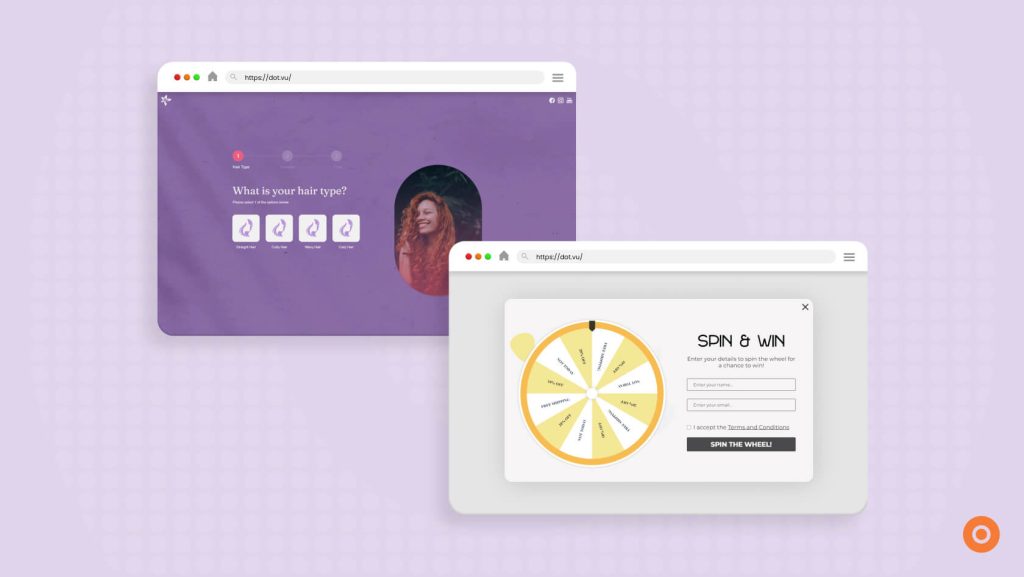
Little branded Marketing Games like spin-to-win wheels, scratch cards, tap-to-collect, challenges. They’re not there to win awards. They’re there to:
- grab attention,
- capture an email or SMS,
- hand out rewards (discounts, gifts, free shipping),
- and make the brand feel a bit more fun than “another 10% off popup.”

Studies have found that adding gamified elements into the experience can increase customer engagement by almost 48%, and gamified loyalty programs can lift retention by around 22%. That’s a serious nudge on the revenue side.
Guided Selling experiences
These feel like a good sales associate, but online. For example:
- “Help me build a skincare routine,”
- “Pick the right mattress for how you sleep,”
- “Find your ideal data plan.”

You ask a few questions about goals, preferences, price sensitivity. The Guided Selling experience then suggests specific products instead of dumping someone on a 200-item category page and saying “go wild.”
Which is why the “one-size-fits-everybody” marketing feels so off now — 71% of consumers expect personalized interactions, and about 76% get frustrated when brands don’t deliver. People basically assume you’ll remember who they are and what they care about.
Shoppable Video
Short “how I use this” clips, tutorials, try-ons, room tours, cooking demos… with products tagged inside the Shoppable Video. You tap, you add to cart, you move on with your life. So it’s great for beauty, fashion, home, food — anything visual.
Interactive Popups
Instead of a boring “10% off your first order,” you get:
- “Answer 3 quick questions, get a tailored routine + an offer,” or
- “Pick your goal and we’ll send you a starter kit recommendation.”

Still a popup. But smarter. Interesting right? Here’s 28 Types of Interactive Popup examples.
Online Advent Calendars and seasonal experiences
These are insanely B2C:
- 12 or 24-day digital experiences where you “open” a door each day,
- get small rewards: discounts, gifts, exclusive content, sneak peeks.

Online Advent Calendars are perfect for beauty, fashion, gourmet food, lifestyle — basically anything that can lean into gifting or “little daily treats.”
The through-line with all of these: they help people choose. They’re not just “for engagement”. Instead, they double as decision support.
B2C Marketing is Helping People Decide, Not Hypnotizing Them
If you strip away all the jargon, what B2C marketing really is comes down to this:
You’re helping someone make a decision they don’t have the time, energy, or information to make alone.
All the things we talked about — marketing games, guided selling, shoppable video, content, email, ads, community, everything — are just different ways of saying:
- “I see what you’re trying to do.”
- “Here’s a clearer, easier way to do it.”
- “Here’s why our thing is the one that makes sense.”
Get that right, keep it human, and you’ll be doing better B2C marketing than your competitors. Try it out for yourself by creating a free trial account and choose from over 300+ Interactive Content templates and get your B2C marketing strategy running smoothly!