TL;DR
Interactive AI fundamentally changes how your content behaves. Instead of serving every single visitor the exact same static page, your digital experience reacts to what they do while they are in it. A quiz can pivot its next question. A calculator can deliver a highly relevant result.
A guided flow gets your prospect closer to their answer instead of forcing them to dig through a massive site. This isn’t about pumping out a higher volume of content. It is about making your user’s experience significantly more helpful while they are still in the decision-making phase.
Why Your Interactive Content Needs to Catch Up?
AI is already shaping how you approach personalization. A recent study shows 73% of professionals believe AI is key to creating customized customer journeys. In the B2B space, people find AI most helpful for things like automation, analytics, and personalization.
Despite this, your team is likely still focused on just producing more content. Faster turnarounds. Less manual work. Is that useful? Absolutely.
But none of that automatically makes the experience better for the person actually using your content. That is exactly where the gap lies.
Generative AI helps you churn out content faster, but interactive AI helps you engage in real time actively. That makes a massive difference when your target audience is trying to narrow down their choices.
Instead of serving up the exact same generic content, you get to offer an experience that shifts based on what they click.
- TL;DR
- Why Your Interactive Content Needs to Catch Up?
- Understanding Interactive AI
- How Interactive AI Compares to Generative AI?
- Turning Interactive AI Into Real Experiences
- What AI-Generated Interactive Content Actually Means?
- Why This Matters More Than Content Volume?
- How to Create Interactive Content With AI Without Overdoing It?
- Where AI-Powered Experiences Usually Go Wrong ?
- When Content Starts Responding, It Becomes More Useful
Understanding Interactive AI
People talk about “interactive AI” all the time, but the meaning isn’t always clear.
Simply put: it is content that responds to a person while they are actively clicking through it. Not later. Not after their browser session closes. Right in the moment.
Instead of forcing users down one fixed path, your experience adjusts based on what the person is actively doing. That might mean changing the very next step, narrowing down their options, or shaping a personalized recommendation as they go.
That is what makes it entirely different from using AI to write a quick paragraph or generate a stock image. It completely changes what your experience does.
A normal article says the exact same thing to everyone. A regular landing page does too. Standard interactive content improves on that by asking people to click, choose, answer, or explore.
Interactive AI adds a smart response layer directly on top of that. It does not just wait for your user’s input; it uses that input to immediately shape what happens next.
How Interactive AI Compares to Generative AI?
These two technologies get bundled together constantly, which is likely part of the confusion. Generative AI is primarily about making something.
You type a prompt, and it hands you text, visuals, or some other output. Interactive AI serves a totally different purpose. It is not focused on producing the asset. It is focused entirely on how your experience responds once someone starts using it. One helps you create the thing.
The other changes how the thing behaves. When you make those two work together, you get AI-generated Interactive Content. That is where your marketing stack starts becoming genuinely useful, rather than just technically impressive.
Turning Interactive AI Into Real Experiences
A lot of your content is probably built to explain concepts. That is fine, up to a certain point. But explanation alone does not always help someone move forward in your marketing funnel. Most people are trying to work a specific problem out. Which option fits their business. What the pricing tier might look like. Whether they are ready to buy. What they should do next.
That is exactly why interactive AI works beautifully in formats that already help people make decisions—like quizzes, calculators, recommenders, or guided flows. Instead of dumping a massive wall of information on a page and hoping it lands, you give people a tool they can actually use.
And when that experience actively reacts as they move through it, it feels less like marketing fluff filling up space and more like a utility built to help them succeed.
What AI-Generated Interactive Content Actually Means?
AI-generated Interactive Content is just a practical way of describing experiences that use AI to shape the user journey while someone is inside it. It does not mean every piece of content needs to turn into a chatbot. It also does not mean you hand your entire website over to an algorithm and let AI do whatever it wants.
Usually, the value you get is much more grounded than that. It is about taking your Interactive Experience and making it feel significantly less rigid.
Your quiz might dynamically change what it asks next.
Your calculator might adjust its core recommendation around the final mathematical result.
Your product finder might narrow things down in a much smarter, intuitive way.
Your guided flow might take people in entirely different directions depending on what they say.
That is the big idea.
AI handles the complex responsiveness underneath the hood, and your prospect simply experiences something that feels incredibly relevant to them.
Why This Matters More Than Content Volume?
Your marketing team might already use AI to write faster, brainstorm faster, and publish faster. That certainly helps. But sheer speed does not solve your biggest issue if the experience still feels totally generic once someone lands on it.
Your prospects still have to figure out what matters to them. They still have to sift through endless options. They still have to connect all the dots on their own.
That is why your conversion problem is usually not a lack of content. It is that too much of your content still leaves all the heavy lifting to the user. Better experiences matter far more than higher output.
How to Create Interactive Content With AI Without Overdoing It?
The easiest mistake you can make here is building way too much. Once AI enters your workflow, it is tempting to add more logic branches, more inputs, and more complexity.
That almost always backfires. A better place for you to start is with one specific thing your audience is trying to sort out. Maybe they want to compare options. Maybe they need a rough estimate. Maybe they are just trying to figure out what fits their setup.
Start exactly there. Then, pick the format that makes that process easier. If they need help choosing, use a recommender. If they need hard numbers, use a calculator. If they need guidance, build an assessment.
After that, be incredibly intentional about what you ask for. You do not need every possible detail about your lead.
You only need the inputs that make the experience more useful for them. Keep it light. If the value only appears after exhausting effort, your users will drop off.

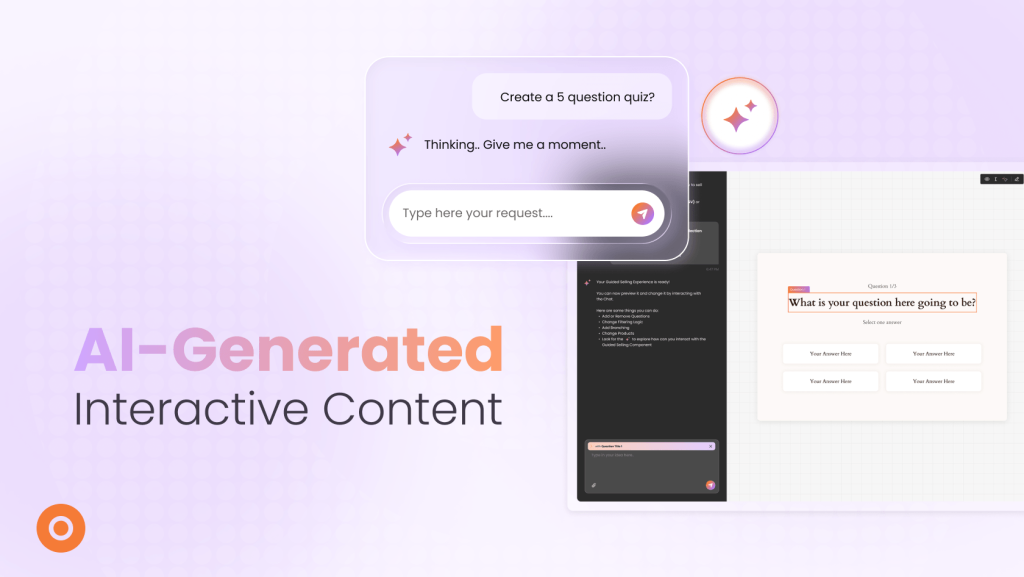
Dot.vu’s AI Interactive Builder helps you with this by letting you turn simple prompts into quizzes, forms, calculators, Marketing Games, and other Interactive Experiences without a massive development cycle. It also helps you seamlessly collect zero-party data as your audience engages.
Where AI-Powered Experiences Usually Go Wrong ?
A few common missteps tend to throw these projects off track.
- Adding AI for show: One big mistake is adding AI just because it sounds good in a pitch, not because it improves your user’s experience. People instantly notice when it is just there for show.
- Fake intelligence: Another pitfall is calling something intelligent when your whole journey still runs on the same rigid logic underneath. A little randomized variation is not the same thing as a system adapting.
- The complexity trap: Complexity is another major problem. More branches do not automatically make your experience smarter. Sometimes they just make it slower, harder, and way more annoying to get through.
- Tracking the wrong metrics: Clicks and completion rates look fantastic in a report, but they do not tell you much on their own. The better question to ask is whether the experience helped someone get closer to a purchasing decision. That is the only part that truly matters.
When Content Starts Responding, It Becomes More Useful
The real value of interactive AI is elegantly simple: it makes your content responsive. And when your content responds, it can do much more than just explain—it can help people move forward.
That is why AI-generated Interactive Content is absolutely worth your attention. Instead of pushing everyone through the exact same fixed funnel, you can create bespoke experiences that shift dynamically based on what people share with you.
For your brand, that means better relevance, clearer buyer intent signals, and far less friction.
If you want to build that kind of experience without dragging your team into a long production cycle, Dot.vu’s AI Interactive Builder gives you a much faster way in. Grab a 14-day free trial and see how easy it is to build your own.
Frequently Asked Questions
Interactive AI is tech that responds to a user’s actions right in the moment. Instead of a one-size-fits-all page, it changes based on what the user clicks or types.
It is Interactive Content that uses AI to shape the journey while someone is moving through it. This means your quizzes, calculators, or product recommenders get smarter and more helpful as a user clicks through them.
First, pinpoint exactly what problem your audience is trying to solve. Next, choose a format that makes solving it easy. Keep the whole process simple, and only ask for information if it actually helps tailor their final result.
Anything that guides your user to an answer tends to pull the best numbers. Think quizzes, guided selling paths, or product recommenders. Your best bet is simply choosing the one that solves your audience’s immediate problem.