

TL;DR (Quick Summary)
Real estate buyers expect far more than static listings and photo galleries. They want to explore properties, compare options, calculate costs, and learn about neighborhoods before ever speaking to an agent.
That creates a huge opportunity for real estate marketers. Interactive Experiences can help attract buyers, generate seller leads, educate prospects, and create more engaging property journeys.
In this guide, we’ll explore how Interactive Real Estate Content can support every stage of the customer journey with practical examples you can start using today.
Why Is Interactive Real Estate Marketing Important?
You might think an interactive real estate content strategy isn’t necessary, but today’s market tells a different story.
Did you know that there are over 2 million realtors in the US? There was also an incredible number of new realtors in 2021 and we are expecting this trend to continue in 2022. We are actually talking about a surplus of realtors. In other words, the competition is fierce in this market.
Moreover, 73% of buyers and 82% of sellers interviewed only one realtor before finding the right agent. This means you should put a particular effort into being the first agent potential client’s approach. Plus, considering that 41% of recent buyers start by looking at properties online and only 19% contact an agent first, your online presence needs to be on point.
That’s where Interactive Real Estate Content comes in. Interactive Experiences help transform passive browsing into engaging journeys, making it easier to educate prospects, showcase properties, and differentiate your brand in a crowded market.
Interactive Real Estate Marketing Starts Here
Discover how Interactive Experiences are helping organizations across the Financial Services, Insurance & Real Estate industry create more engaging customer journeys.
Best Practices for Creating Interactive Real Estate Content
Every time you create Interactive Real Estate Content, think about how it reflects your brand. In real estate, trust and credibility are everything.
First, position yourself as an expert in the housing market. Your audience should feel confident that you understand the market, have their best interests at heart, and can provide reliable guidance throughout their buying or selling journey.
Second, position yourself as a local expert. Show that you know your area inside and out, from schools and restaurants to parks, attractions, and community amenities. The more helpful and knowledgeable you appear, the easier it becomes to build trust with potential clients.
Here are a few best practices to keep in mind:
- Educate your audience.
Keep producing educational content that will help your potential customers make the right decisions. - Engage users.
Make sure your content includes elements of gamification or competition. - Include lead forms.
Gate parts of your content with lead forms to grow your email list and generate leads. - Provide value.
Whether you give valuable insights about their future homes, financial situations, or possible neighborhood choices, remember to always provide highly valuable content. - Add branding.
Always include branding elements such as logos, colours, and even tone of voice to create awareness around your real estate brand.
12 Interactive Experiences for Real Estate Marketing
As mentioned earlier, we’ve grouped these Interactive Experiences according to the different marketing goals a real estate broker may have.
Grow your social media accounts
If you are not already on social media, that should become a priority. You might think you don’t have the time, or that you already have a strong base of clients. However, social media remains an important part of long-term marketing for real estate professionals. 76% of realtors use Facebook for their work. Moreover, GenX is currently the biggest buying group of houses followed closely by the Millenials. These two generations, with a particular focus on millenials, are known to be major social media users. Meet them where they hang out, as we say!
But, how do you grow your social media accounts with Interactive Real Estate Content? Of course, the first step would be to post useful and Interactive Social Media posts that engage your followers.
1. User-Generated Content Contest
User-Generated Content is content created by your clients rather than yourself. For example, you could encourage all new buyers to share a picture of themselves holding a bottle of champagne in front of their new house. User-Generated content is an awesome type of Real Estate Marketing Content because the post will reach the Facebook friends of your clients. If their friends are interested in buying or selling their houses, they will see these posts as approval. Thus, they might follow you to learn more about you.

2. Tag-a-friend Post
Did you know that 90% of people are much more likely to trust a recommended brand (even though it was recommended by strangers)? While User-Generated content is amazing, it’s not the easiest because you don’t control who posts. So, another less effective but more accessible idea would be “Tag-a-friend” posts. These posts aim to encourage your followers to tag their friends in the comment section. Accordingly, you increase your visibility and hopefully gain new followers.
For example, if a new Italian restaurant opened in the area, you could post something like this on your Facebook account:

This is also a great example of a post that will position you as an ambassador for the region. Win-Win!
Encourage engagement on social media
Growing your social media account is important. But you also want to entertain your current followers, so they keep you at the top of their minds. In most realtors’ social media accounts I know, the realtor only posts about new listings. While posting new listings is extremely important, and you might not have much time to post about other things, it is also quite boring. So, how can you easily engage with your audience online? Let’s look at these 2 examples of interactive real estate content.
3. Quizzes
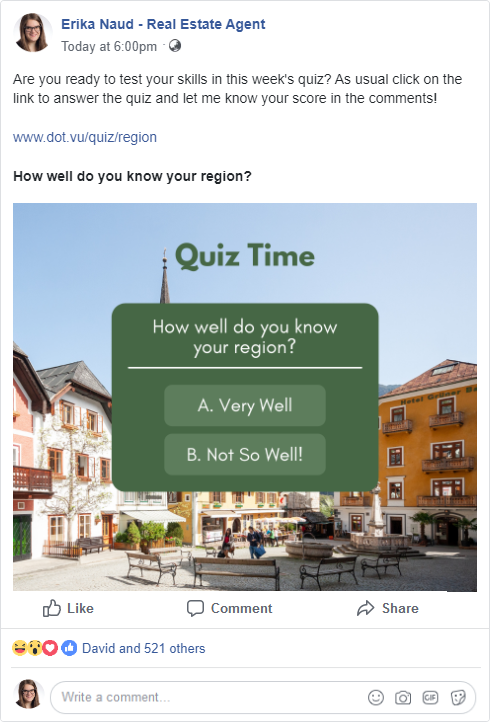
An easy way to entertain your social media followers is with quizzes. Again, think about the fact that you want to position yourself as an expert on the housing market and an ambassador for your region and design simple quizzes around that. Quizzes’ ideas could be “How well do you know your region?” or “How well do you know the financial requirements for borrowing money to buy a house?”.
Quizzes are amazing tools because they succeed in positioning yourself, engaging your audience, and educating them.
4. Polls
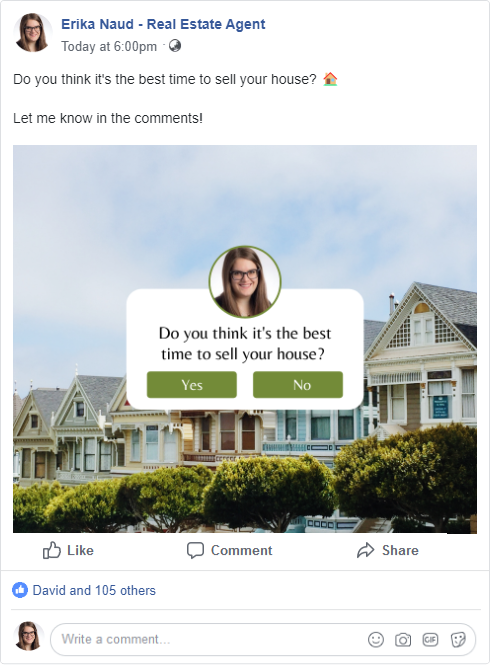
Polls have similar benefits as quizzes. Plus, social media users generally love them. Keep it simple and ask questions like “Do you think it’s the right time to sell your house?” or “Where is the best pizza in town?”.
Boost Sales
We know that ultimately the best tools of a broker are their negotiation skills, their charisma, and their ability to uncover the needs of their clients. Nonetheless, when you know that nearly 95% of buyers used online tools to buy houses, you understand why you can’t rely simply on your good salesman skills. So, here you can find 2 online tools to help you out!
5. Product Finder
With a Product Finder, or should I say a House Finder, you ask a series of questions to potential buyers to showcase to them the best houses that match their answers. It allows you to uncover the specific needs, characteristics, and preferences of potential buyers while also educating them on the current houses available on the market. Stop relying on the boring filtering options that you can find on every Real Estate website and start offering a premium Interactive User-Experience on your website.
For 52% of buyers, the main reason for having an agent is to get help to find the right home. This Interactive Real Estate Experience can help you do just that. Have a House Finder on your website where you ask questions such as
“Do you mind doing housework in your new house?”
a) I want to avoid renovations and problems at all costs
b) I want the best value and I am prepared to work for it
c) A mix of both
Follow the gated content best practices, and gate the result of your House Finder to grow your email list. Plus, collect the answers of your House Finder so you know exactly what the potential buyers are looking for when contacting them!

6. Interactive Virtual Tours
On average, buyers spend 8 weeks finding their new house and they look at approximately 8 houses. That’s quite a lot of visits. Interactive Virtual Tours is a way for you to reduce the number of visits and only show houses that the potential buyers are really interested in.
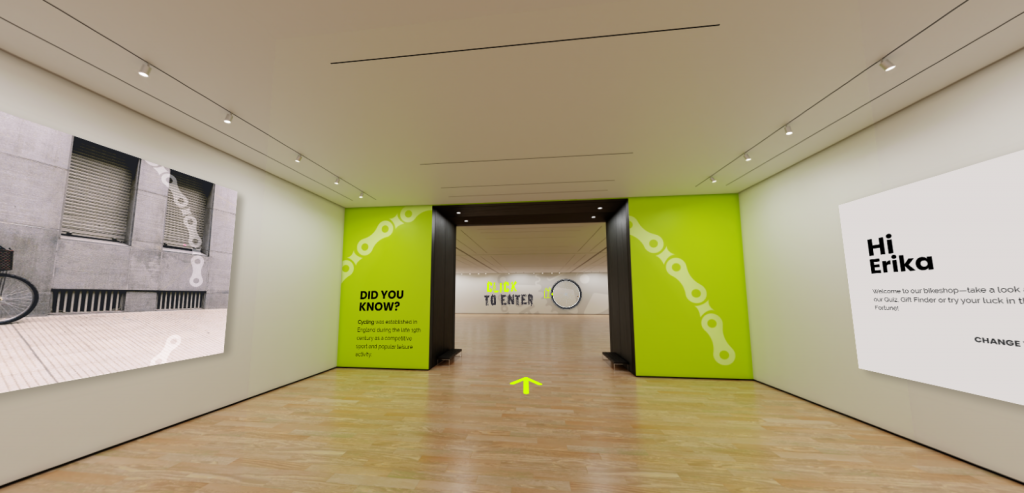
What is an Interactive Virtual Tour? It’s an Interactive Experience where your visitors feel like they are physically present in the rooms when visiting a house. They visit the house the same way they would do it if they were physically there. Because of the Interactivity of the experience, they can explore the house as if you were also with them. Clicking on touchpoint to learn more about specific aspects of the house such as the built-in foyer, or the luminosity in a specific room. You could also add other fun Interactive Experiences to the tour such as Interactive Calculators, Lead Forms, Quizzes, and so on.
Have you ever tried an Interactive Video Tour? If not, check it out!
7. Interactive Videos
Another idea, similar to Interactive Virtual Tours, is to create Interactive Videos of your houses on the market. An Interactive Video would allow you to show the house as you would normally do. You’d go around and present to potential buyers what’s great about this specific house. But, within the video, buyers could click on specific items to learn more about them. An Interactive Video is a linear or branching experience, meaning that it does not offer potential buyers the same possibilities as an Interactive Virtual Tour. But, it’s better to personalize the house tour because you’d be presenting, talking, and adding a human touch with charisma.
Check out this Interactive Video example:

8. Interactive Flipbooks
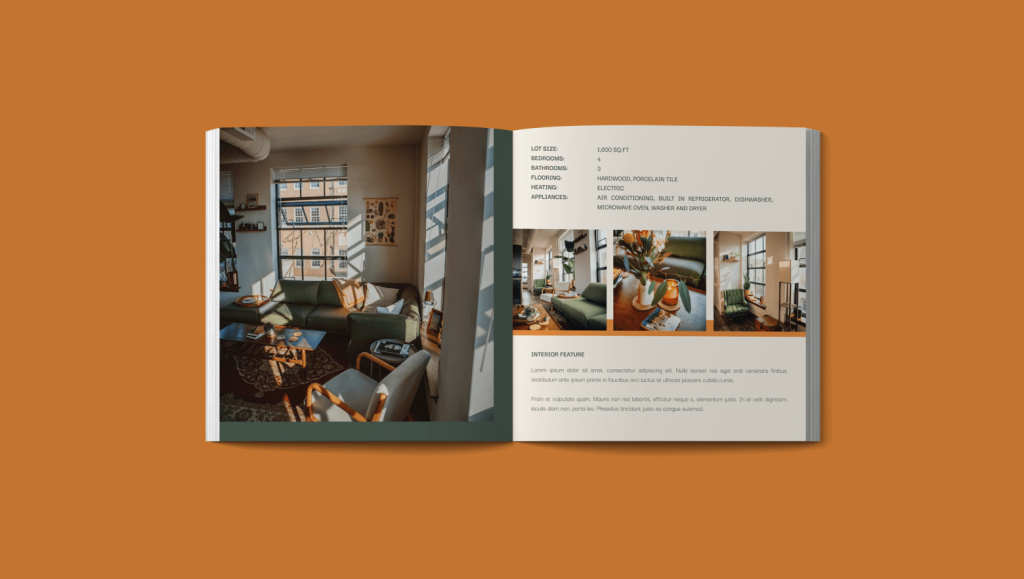
Another interesting interactive real estate content idea to showcase your products and boost sales could be Interactive Flipbooks and catalogs. Lots of real rstate agencies started doing online magazines nowadays, where they advertise their new listings. But what if we told you there was another and better way of doing that? A way that is engaging and interactive! Indeed, Interactive Flipbooks could be an awesome interactive real estate content idea to implement!
Would you like to see what an Interactive Flipbook is? Then, take a look at this example! This Real Estate Catalog features a realistic page flip effect, stunning animations, and clickable elements to engage users to the maximum.

Get new listings
While selling houses is the most important thing for brokers, getting new listings is very important as well. Did you know that 68% of sellers found their agent through friends & family, or because they used that agent before?
In other words, the best strategy to gain new listing is to work on Customer Loyalty and Word-of-Mouth. Here are 2 Interactive Real Estate Content examples to help you do that:
9. Marketing Events
This specific type of Interactive Real Estate Content is a great way to build loyalty. Create an annual event where you thank your clients for having trusted you this year. Hire your best caterer, make sure the cocktails are on point and find a reliable DJ. Create a magical event where your clients can have fun. If you specialize in selling secondary houses, think about having hybrid events.
Pro Tip: Promote your event with Interactive Content.

10. Annual Interactive Contest
Another interesting real estate marketing content to get new listings could be to encourage sellers to choose you over other brokers with an Annual Interactive Contest. While having an annual contest won’t be the main decision-making point it can be a little plus to differentiate you.
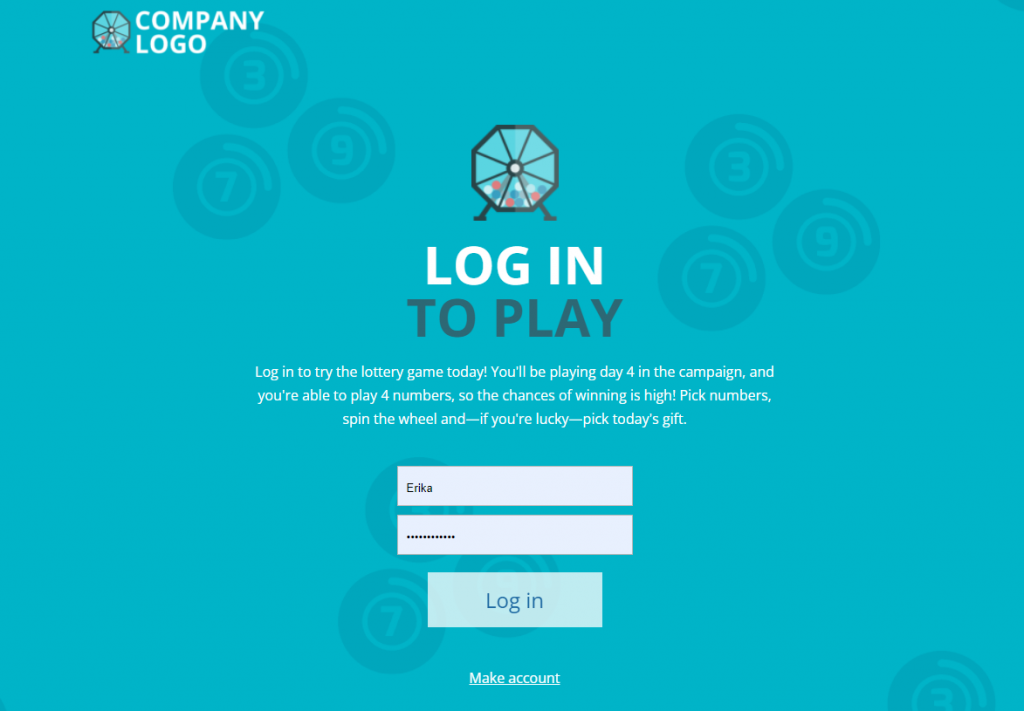
The idea here is that every year you have a big contest where only the sellers you worked with during the year can participate. Remember that for it to work, the price must be worth it. Forget the little fruit basket, think bigger. An idea could be gift cards for expensive activities in the region, like Massages & Spa, Helicopter Tours, and so on.
To make it even more entertaining, you could add a Marketing Game to your Interactive Contest. Check out this lottery game as an example:
Manage your time better
Time is money in the real estate world. You are all extremely busy. But do you take the time to reflect on how you can optimize your time?
Look at these 2 interactive real estate content examples:
11. Interactive Calculators
Did you know that 87% of recent buyers financed their house and that first-time buyers typically financed 93% of it? How much time did you spend with potential buyers to finally realize they were looking at houses out of their budget and they didn’t pass the financing conditions? What if there was a way to help with that without asking personal questions directly to potential buyers?
Instead, you could have Interactive Calculators on your website. With your Interactive Calculator, potential buyers could find out what their budget for a house should be depending on their revenue, their savings, and their debt.

12. Interactive Assessment
But you also spend lots of time with buyers that aren’t sure what they are looking for? They look around hoping to find their perfect house and have the ultimate feeling of “this is the one”. But, let’s be honest, that feeling is rarely there! Unless you build your house, there will always be some negative points to it.
So, how do you make sure you don’t spend lots of time showing houses that are never going to cut it? You could use an Interactive Assessment on your website! Ask important questions like:
When choosing your neighborhood what’s the most important for you:
a) Convenience to family and friends
b) Convenience to jobs
c) Convenience to facilities
An Interactive Assessment is a great type of Interactive Real Estate Content because it helps your customers reflect on what their preferences are. Plus, at the end of the questionnaire, depending on their answers, they would have a description of what they should be looking for.
Another very important aspect of an Interactive Assessment is that you have access to the answers. So, you will be better equipped to meet these potential clients and find houses that match their needs.

Ready to implement some of these interactive real estate content ideas?
Real estate marketing isn’t just about showcasing properties anymore. Buyers and sellers expect experiences that help them make informed decisions with confidence.
Whether you’re generating seller leads, promoting listings, or educating first-time buyers, Interactive Experiences can help create more engaging and effective customer journeys.
At Dot.vu, you can build these experiences using 20+ Interactive Solutions and 350+ customizable templates to support every stage of the real estate journey.